Managing Fatigue in Amputee Football
Tips For Amputee Football Tournaments to Avoid Injury
Fatigue is a common issue for many athletes across different sports. With the strain placed on a single lower limb as well as the extra load on upper limbs from crutch running, Amputee Football players experience additional factors contributing to fatigue.
We’ve worked in partnership with the England Amputee Football Association medical team on this handy guide which looks at some of the tips and techniques they use to help manage fatigue in their players.
While this guide has obvious applications for amputee footballers, the below points can be easily applied to other versions and different levels of football as well as athletes who take part in other sports.
You should note that this is intended as a guide for informational and educational purposes only and is not a substitute for professional medical advice, diagnosis, or treatment. As such it is not intended as medical advice. We recommend that you always seek professional medical help for injuries, treatment or assessment.
Fatigue in Amputee Footballers, by Niall Hogan, Medical Lead for the England Amputee Football Association.
At the England Amputee Football Association (EAFA) we compete at the highest level of disability sport.
Our teams play in many major tournaments such as World Cups, European Championships and Nations Leagues, as well as invitational friendlies and small tournaments.
These competitions are intense, usually played across one week or sometimes just a weekend, which means teams usually compete in games every day or occasionally two games in one day.
Therefore, for our medical team, managing fatigue is vital to avoid injury and keep player's performance at its best.
Here are some of the key techniques we use during elite competition to manage an intense schedule and avoid fatigue related injuries.

1. Flexibility
Throughout competitions we run recovery sessions for players where we often use a combination of stretching and foam rolling.
We also encourage our players to use the techniques and movements we teach them for self-directed recovery.
Using correct technique, foam rolling can provide a versatile treatment option for many muscle groups and allows our players to control the pressure depending on preference, tolerance and their personal level of discomfort.
These routines can help combat fatigue by reducing soreness, improving circulation and aid in removing lactic acid build-up.

Using products like the Physique Massage Roller, each player can effectively release muscle tightness and prepare for the next game.
See other guides on Improving Flexibility and Foam Rollers for further information and guidance.
2. Soft Tissue Massage
Alongside the tournament’s intensity, the players cover large distances throughout the game, and the style of play is very mobile, agile and often non-stop. This causes a higher level of muscle fatigue and puts players at risk of overuse injuries such as tendinopathies or muscle strains. When games are on back-to-back days, or on the same day, this load can build up if not appropriately managed.
As a medical team, we advise players to have soft tissue massage treatments for specific areas of tension/discomfort, or general oedema/tightness flush through massages, especially ahead of important games, later in tournament schedules or in between games on two-game days.

At EAFA we like to use Songbird Sports Massage Wax for our soft tissue treatments, as this wax has the ideal consistency for smoother but better controlled deep tissue releases.
There are also many different Massage Tools which can help clinicians protect themselves and reduce strain on their hands during treatments, particularly during competitions where several players may need treatments consecutively.
See the Hand Strain In Massage Therapists guide for more information.
3. Cold Therapy
In Amputee Football, load through the ankle is increased and as a result this is the area where it is more common for us to see fatigue and inflammation and, if not managed correctly, injury. Ice foot baths are an effective way for us to control inflammation, promote circulation and improve lymphatic drainage which all help with addressing fatigue in our players.
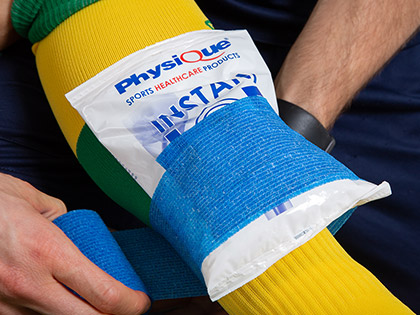
We use Physique Instant Ice Packs or Physique Elite Reusable Hot & Cold Packs for instant use when there is an acute injury or for quick relief.
As part of their recovery protocols and competition routines, some of our players like to do ice baths for generalised full body recovery.
See the guide on Benefits of Ice Baths for more information and commonly asked questions about ice baths.
4. Taping
Taping techniques can help us manage fatigue in various ways. We do take a unique approach to every player’s care, however there are some common areas that we use tape for.

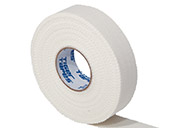
Tiger Tape Zinc Oxide Strapping, which we typically use in the 5cm or 3.8cm width, provides a more rigid support. We will most often use this for heel locks and ankle/ATFL stirrups. Due to the increased load through the leg and altered centre of mass for amputee players, fatigue through the ankle can increase. Therefore in a case where fatigue is greater, we can use the rigid Tiger Tan Zinc Oxide to control the ankle.
K-tape allows us to provide proprioceptive control and postural support. We like to use Tiger K Tape 5cm x 5m particularly for shoulder/scapula support, due to the increased loading and movement through the shoulder with crutch running.
We use Tiger Tear EAB 7.5cm or 5cm, or Tiger Rip Lite Cohesive for compressive taping techniques to help control swelling following games, or compressive, supportive wrist taping. In Amputee Football we also sometimes use cohesive bandage for hand wraps to cover blisters whilst still giving a surface that helps players grip the crutches.
5. Prehab Activation
At EAFA, our medical team work alongside our strength and conditioning department to provide players with prehab programs throughout the season, as well as key activation work during warmups and before starting the second half of games.
Three key areas we focus on as part of our prehab are banded activation, speed/agility and proprioception.
Physique Mini Bands, Physique Resistance Bands and Power Bands are great options for various muscle activation exercises. They provide good, varied resistances and versatile options for different movements and muscle groups.

In Amputee Football, good crutch control can help improve performance. We use speed and agility drills to make crutches feel like an extension of the body. Acceleration/deceleration, rapid changes of direction especially with reactive responses to coach instructions and plyometric movements, are just some of the key principles we use in our prehab activation.
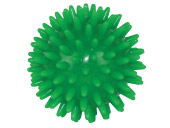
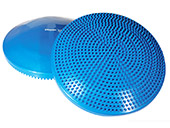
Every player has slightly different biomechanics, and playing on crutches can alter their centre of mass slightly. These factors can lead to increased risk of ankle injuries like inversion sprains and weaker lumbopelvic control. Through proprioceptive work like balancing or squatting on a Physique Wobble Air Cushion, we can help improve control and reduce injury risk.
All of the prehab techniques help us to improve efficiency during performance and reduce the build-up of fatigue.


Did you find this article useful?
Why not share this with a colleague, patient or friend?